The Bag Rules That Decide Your Whole Concert Outfit
Quick Answer: Most large venues cap bags at around 12x6x12 inches, and many stadiums require clear bags or allow only a small clutch. Since the bag determines what you can carry, decide it first — then the outfit has to supply pockets for whatever the bag cannot.
You plan the outfit, then discover at the door that your tote is three inches too big, and now you are deciding what to abandon in a bin outside a stadium.

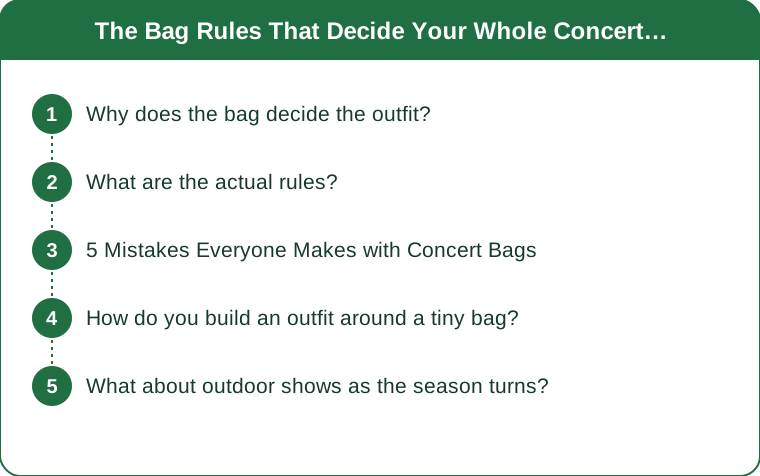
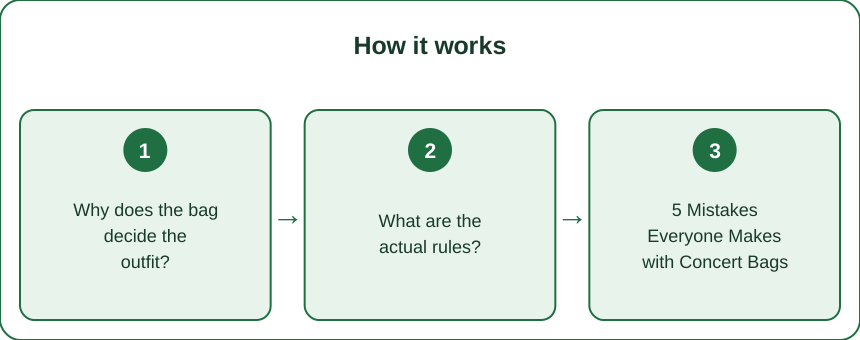
Why does the bag decide the outfit?
Because it determines where everything lives, and everything you cannot carry has to be worn or left behind.
A typical evening requires a phone, a card or wallet, keys, a light layer for the walk back, and possibly earplugs. That is a real volume. If the venue permits a normal crossbody, none of it touches the outfit.
If the venue requires a clear bag or a small clutch, three things change immediately. You need genuine pockets — which rules out a lot of dresses and most fitted trousers with decorative pockets. You need a layer you can tie or wear rather than pack. And whatever is in the clear bag is visible, which most people would rather think about in advance.
So the sequence is: check the policy, then choose the outfit. Reversing it is how the bin outside the gate stays full.
What are the actual rules?
They vary, but the common patterns are worth knowing:
- Arenas and theatres: frequently a soft-sided bag limit around 12 x 6 x 12 inches. Most crossbodies pass.
- Stadiums: often a clear bag policy — a clear plastic tote up to about 12x6x12, plus a small non-clear clutch roughly the size of a hand.
- Small venues and clubs: usually the loosest rules, sometimes no stated policy, but the least storage and the tightest crowds, which argues for small anyway.
- Festivals: vary enormously, often allowing backpacks but banning specific items.
Check the venue’s own site the week of the show, not a general guide. Policies change between seasons and between promoters, and the rule that applied last year may not apply now. The event page is the authority.

5 Mistakes Everyone Makes with Concert Bags
1. Checking the artist’s page instead of the venue’s. Tour pages rarely list bag policy. The venue page does.
2. Bringing a bag that just fits. A bag at the exact limit gets measured. A bag comfortably under it gets waved through. Aim under, not at.
3. Forgetting the layer. In late summer the walk in is warm and the walk out at 11pm is genuinely cool. If the bag cannot hold a layer, the outfit has to include one you can tie at the waist.
4. Rigid over soft. Many policies specify soft-sided. A structured mini bag with a frame can fail a rule that a slouchier, larger bag passes.
5. Long straps in a standing crowd. A strap at hip height gets bumped, ridden up, and stood on. Shorten it so the bag sits at the front of your waist — the fifth one is the difference between a comfortable night and constantly adjusting.
How do you build an outfit around a tiny bag?
Move the storage onto your body.
Pockets are the whole game. Wide-leg trousers with real pockets, a jacket with an interior pocket, or a utility-style skirt. Test them standing up — a pocket that holds a phone when you are seated and dumps it when you dance is not a pocket.
A layer you can wear. An overshirt or light jacket tied at the waist takes zero bag space and solves the 11pm walk to the car. This is also why a cropped jacket beats a long coat for a standing show — nothing to sit on, nothing to drag.
Reduce the payload. Phone, one card, one key. Leave the wallet in the car. Digital tickets and tap-to-pay have made this genuinely feasible, and the security line is faster when you are carrying almost nothing.
Shoes you can stand in for four hours are the other non-negotiable, and no bag rule affects them.
What about outdoor shows as the season turns?
Late-summer outdoor shows are the hardest brief of the year, because the temperature swing between doors and encore can be 20°F or more.
The reliable structure:
- A base you are comfortable in at 78°F standing in sun.
- One mid layer — long sleeve or overshirt — that ties at the waist and does not need the bag.
- One thing for your legs if the venue is on grass. Damp evening grass through thin fabric is the underrated misery of outdoor shows.
- Something for your ears. Earplugs take no space and are the only item on this list you will still be grateful for tomorrow.
If the forecast includes any chance of rain, a packable shell is worth the bag space it costs, because venues rarely allow umbrellas and the queue to leave is long.
TL;DR:
- Venue bag policy determines what you can carry, so check it before choosing the outfit.
- Common limits are around 12x6x12 soft-sided, with clear-bag rules at many stadiums.
- If the bag is tiny, the outfit must supply real pockets and a layer you can tie at the waist.
- Aim comfortably under the size limit rather than at it, and shorten the strap for standing crowds.
The whole problem disappears with one search on the venue’s own site the week of the show. It is a thirty-second check that decides whether you spend the evening enjoying the set or reorganising your pockets in a security queue.
Keep Reading
This article is for general informational and styling purposes only. Fit, sizing, and product availability may vary.