What to Wear When Doors Are Three Hours Before the Band You Came For
Quick Answer: Plan for the wait, not the show. Doors three hours before your headliner means roughly four to five hours on your feet including the queue, across a temperature range from a warm evening outside to a hot crowded room and back to a cold night. The formula that works: a supportive broken-in shoe, a mid layer you can remove and tie or stash, a cross-body bag that meets the venue’s size policy, and a base layer that handles sweat. Choose the shoes first - everything else is recoverable and they are not.
The band you bought the ticket for comes on at half nine. Doors are at half six. There are two support acts you have not heard of, and if you want to be near the front you are queuing from five.
So the outfit has to survive about five hours, most of which nobody plans for.

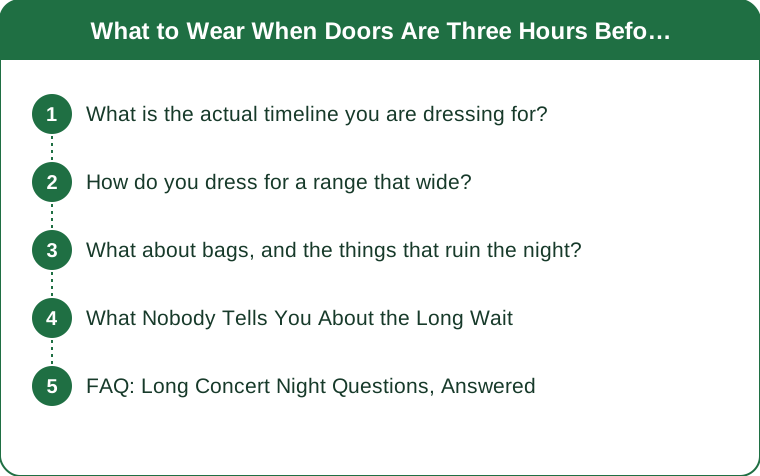
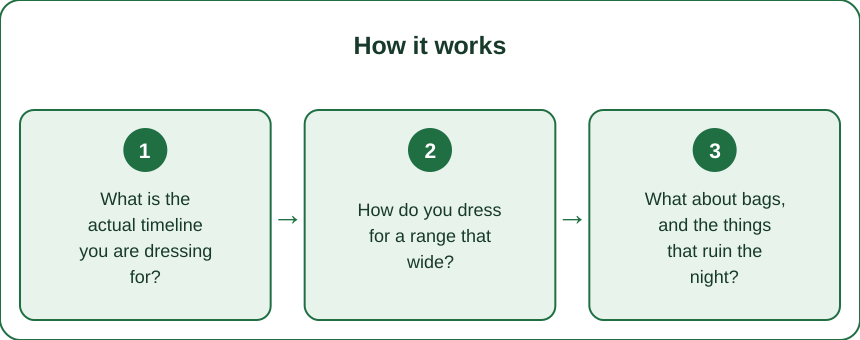
What is the actual timeline you are dressing for?
Break it into four phases, because they have genuinely different requirements.
Phase one - the queue, one to two hours. Outdoors, standing on pavement, in whatever the weather is doing. In late summer that means warm and possibly still sunny at five, cooling quickly after seven. No seating, no shelter, and usually nowhere to put a bag down.
Phase two - doors to first support, up to an hour. Inside, moving around, finding a spot, getting a drink. The venue is not yet full so it is not yet hot.
Phase three - support acts, one to two hours. Standing still in a filling room. This is where the temperature climbs fastest and where footwear becomes the dominant factor.
Phase four - the headliner plus the exit, two hours. Peak heat and density, then abruptly outside into a cold night, often with a walk to a station.
The range you are dressing across: a warm pavement at five, a room that could be ten degrees warmer than outside by nine, and a cold street at midnight. Plus around five hours upright with no opportunity to sit.
That is a harder brief than most people’s work day, and it is usually approached as an outfit question rather than a logistics one.
How do you dress for a range that wide?
A three-layer structure where the middle layer is removable and stashable, and shoes chosen for hours rather than for the outfit.
Shoes - decide these first. Five hours standing on concrete is the single biggest determinant of whether you enjoy the night. Requirements: broken in, supportive, closed toe.
- Closed toe is not optional in general admission. In a crowd your feet get stepped on, and drinks get spilled.
- Broken in means genuinely worn already. A gig is not the place to debut anything.
- Cushioning matters more than you think on a hard floor, which is a different demand from walking - standing still on concrete is harder on your feet than moving.
- A low chunky sole or a supportive trainer beats both a flat with no cushioning and any heel.
Base layer. Something that handles sweat and does not show it. A fitted cotton-blend or technical tee. Avoid pale grey, silk, and anything that marks. You will be warmer than you expect.
Mid layer. The one you take off. An overshirt, a light knit, or a zip-up you can tie around your waist or stuff in a bag. This is the piece that covers the queue and the walk home, and it needs to be genuinely stashable - a bulky jacket you have to carry all night is a mistake you make once.
Bottoms. Comfortable, with real pockets if possible, in something that will not show a spilled drink. Dark denim, black trousers, or a comfortable dark skirt with shorts underneath if the crowd will be dense.
The coat question. If it is cold enough that you need a real coat and the venue has no cloakroom, you will be holding it for five hours. Either check the cloakroom situation in advance, or wear a mid layer that is warm enough on its own and accept a brisk walk home.

What about bags, and the things that ruin the night?
The bag policy is the most common thing that goes wrong before you are even inside.
Check the venue’s bag policy before you leave. Many larger venues restrict bag size, and stadiums increasingly require clear bags. Arriving with a bag that does not comply means either a long walk to a locker or leaving it somewhere, both of which cost you your place in the queue.
Cross-body, worn in front in a crowd. Not a shoulder bag that slips, not a backpack you cannot see. In a dense crowd, a small cross-body bag worn across your front is both secure and out of the way.
What actually needs to be in it: phone, payment, ID, keys, a small water bottle if permitted, and earplugs. That is it - a smaller bag means a faster security check, which matters more than it sounds when doors open.
Earplugs deserve a specific mention. Musicians’ earplugs reduce volume across frequencies rather than muffling, so the sound stays clear. Standing near the front of a loud show for two hours without them risks genuine hearing damage, and the ringing afterwards is your ears telling you it already happened. They cost very little and take up no space.
Four other things that reliably ruin a night:
A phone at 20 percent. Five hours plus a journey home. A small power bank is worth its weight, and check whether the venue permits it.
No water. A hot crowded room for four hours is dehydrating, and it is the actual cause of most people feeling unwell at gigs. Drink water before you go in and during.
Long loose hair down in a packed hot room. Bring a tie even if you plan to wear it down.
Anything that dangles. Long necklaces, hoop earrings, and loose scarves all catch in a crowd. Minimal jewellery is a practical decision rather than a style one.
What Nobody Tells You About the Long Wait
The queue is a different social event from the gig, and dressing for it changes the evening.
If you are queuing for two hours you are standing next to the same people the whole time, usually chatting, often sitting on the pavement at some point. Being comfortable enough to sit down on a kerb is a genuine advantage - and it is worth knowing that a white or pale bottom half makes that impossible.
The temperature drop after the show is the most underestimated part. You come out of a hot room, soaked with sweat, into a cold night, and then stand waiting for transport. That combination is why people are cold on the way home in a way that has nothing to do with the actual temperature. The mid layer you carried all night is for this moment, and it justifies itself entirely in that fifteen minutes.
Small venues get hotter faster than big ones. A room holding 300 people with limited ventilation reaches an uncomfortable temperature within twenty minutes of filling. An arena barely changes. If you do not know the venue, assume the smaller and hotter case.
The support acts are usually the best part of the crowd experience. The room is less dense, you can move, and it is the window to get a drink or use the toilets without losing twenty minutes. Planning around that - go during the changeover, not during the headliner - is worth more than any wardrobe decision.
And on standing still specifically: five hours of standing without moving is harder on your legs and lower back than five hours of walking, because the calf muscle pump is barely working. Shifting your weight regularly, standing on one foot then the other, and walking around during changeovers makes a real difference to how your legs feel at eleven. It sounds trivial and it is the difference between enjoying the encore and counting the songs.
FAQ: Long Concert Night Questions, Answered
Do I really need different shoes than I would wear out normally?
If you are in general admission for five hours, yes. Standing on concrete without moving is a specific demand and shoes that are fine for an evening out often are not fine for it. If you are in a seated show, this matters far less.
How do I dress up without being uncomfortable?
Put the effort where it does not cost anything - top half, makeup, jewellery that is not dangly - and keep the shoes and bottom half practical. In a dark crowded room nobody can see your shoes, which makes them the cheapest place to be sensible.
What if the venue has no cloakroom and it is cold?
Wear a mid layer warm enough to walk in and skip the coat. Layering two thinner things is better than one thick one, because you can shed one and tie it. Check the venue’s website - cloakroom availability is nearly always listed.
Is it worth queuing early if I am not fussed about the barrier?
Often not. If you are happy a few rows back, arriving after doors saves you two hours of standing and costs you very little. The queue is worth it for the barrier and largely not worth it otherwise.
TL;DR:
- You are dressing for five hours, four phases, and a wide temperature range - not for the headliner.
- Choose the shoes first. Broken in, closed toe, cushioned. Standing still on concrete is harder than walking.
- Three layers with a stashable middle one. That layer covers the queue and the cold walk home.
- Check the bag policy before leaving and wear a small cross-body in front. Clear-bag rules catch people out constantly.
- Earplugs and a power bank are the two small items that most reliably improve the night.
- Use the changeovers for drinks and toilets, and shift your weight while standing - your legs will thank you at eleven.
The headliner is two hours of the five. Dress for the other three and the two you came for get considerably better.
Keep Reading
This article is for general informational and styling purposes only. Fit, sizing, and product availability may vary.