What to Wear to a Small Venue That Gets Unbearably Hot Within Two Songs

Quick Answer: Dress for the room, not the walk. Small packed venues get hot within two songs and stay hot, so the outfit that works is a breathable base you’re happy to be seen in for three hours, plus exactly one outer layer you can tie around your waist or fit in a small crossbody bag. Natural or performance fabrics over synthetics that hold heat, closed shoes with grip because floors get wet, and nothing you have to hold - anything in your hands ends up on a sticky floor.
The coat decision is made at the door and you regret it either way: a cloakroom queue at the end, or wearing it in a hundred-degree room. Solve it before you leave the house.

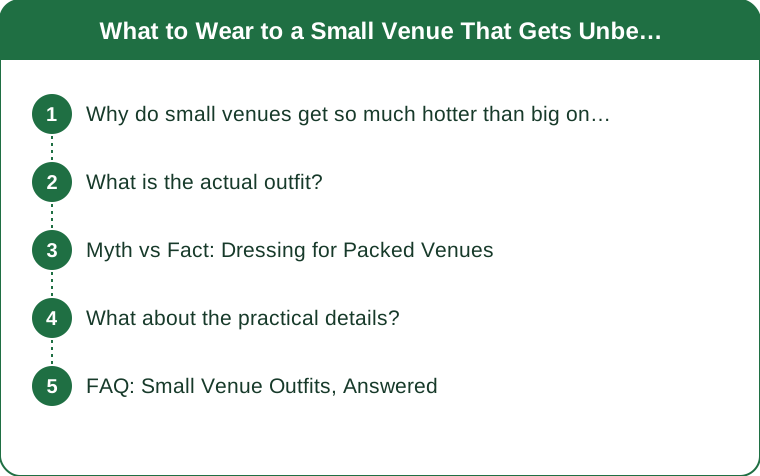
Why do small venues get so much hotter than big ones?
Body heat has nowhere to go. Several hundred people in a low-ceilinged room generate a substantial amount of heat, and small venues rarely have the air handling capacity to move it. Large arenas have volume and ventilation; a converted pub back room has neither.
Humidity rises as fast as temperature. Perspiration from a packed crowd raises humidity, and high humidity is what makes heat genuinely unbearable rather than merely warm - your own sweat stops evaporating effectively.
Stage lighting adds real heat. In a small room, the lighting rig is close to the crowd and contributes noticeably, particularly for anyone near the front.
There’s no escape route. In a big venue you can move to a concourse, a bar, or an outer ring. In a small one, leaving the room usually means losing your spot.
And you arrive dressed for outside. As evenings get colder, the gap between the walk there and the room itself widens - which is exactly the problem this article exists for.
The temperature peaks fast and stays. It’s typically hottest within the first two or three songs of the main set and stays there. Planning for the average temperature of the evening is planning for a temperature you’ll never experience.
What is the actual outfit?
A breathable base you’d happily wear all night. A cotton or linen-blend top, or a technical fabric designed to move moisture. This is the layer you’ll actually be wearing for the whole show, so it needs to work on its own.
Avoid heavy synthetics against the skin. Polyester and similar fabrics that don’t breathe hold heat and show sweat marks distinctly. Natural fibres or purpose-built performance fabrics handle it far better.
One outer layer, chosen for portability. A light jacket or overshirt you can tie around your waist, or a packable one that fits in a bag. The test is whether you can carry it hands-free for three hours.
Skip the coat entirely if the walk allows it. A warm base layer plus a light jacket usually beats a proper coat, because the coat becomes a liability the moment you’re inside.
Closed, grippy shoes. Small venue floors get wet with spilled drinks, and they get stood on. Open toes are a genuinely bad idea in a packed standing crowd.
And a small crossbody bag, worn across the body. Hands free, secure in a crowd, and it holds a layer, a phone, and keys. Anything you carry in your hands spends the evening being negotiated.

Myth vs Fact: Dressing for Packed Venues
Myth: Wear less and you’ll be fine. Fact: the walk there, the queue outside, and the walk home are all cold now. The answer is one removable layer, not fewer clothes.
Myth: The cloakroom solves the coat problem. Fact: it solves it at the start and creates a twenty-minute queue at the end, in a corridor, while everyone else leaves. Many small venues don’t have one at all.
Myth: Black hides sweat. Fact: black hides sweat marks better than mid-tones like grey and light blue, but heavy black synthetic fabric still holds heat. Fabric matters more than colour.
Myth: You should dress up for a gig. Fact: at a small standing venue, comfort visibly outperforms effort. The outfit you’re still happy in at song fourteen is the one that worked.
Myth: Trainers look lazy. Fact: in a standing crowd on a wet floor for three hours, they’re the correct answer, and a clean pair reads as intentional. Heels in a packed small venue are a genuinely poor trade.
Myth: You can just step outside to cool down. Fact: in a small venue, stepping out usually means losing your position, and re-entry policies vary. Plan the outfit as if you’re staying put.
What about the practical details?
Tie your hair up or bring something to. It’s a small thing that makes a large difference in a hot room, and a hairband weighs nothing.
Check the venue’s bag policy before you go. Many venues have size restrictions, and discovering yours at the door with no cloakroom is the worst possible time.
Wear something you can move in. Standing crowds shift, and a restrictive waistband or a top that rides up becomes the thing you think about all night.
Bring water or plan to buy it. Hot packed rooms dehydrate you faster than you’d expect, and most venues will refill or sell water.
Consider the walk home separately. The layer that seemed excessive at the venue is exactly right at midnight in October, which is the whole reason to carry one rather than to leave it behind.
And know your limits in a hot crowd. Feeling faint, dizzy, or unwell in a packed hot room is worth acting on immediately - get to the edge, get water, and tell staff. Venue staff deal with this routinely and would much rather help early.
FAQ: Small Venue Outfits, Answered
What should I wear to a small gig?
A breathable base you’re happy to wear all night plus exactly one removable outer layer you can tie around your waist or fit in a small crossbody bag. Closed grippy shoes, nothing you have to carry in your hands.
Should I bring a coat to a standing gig?
Usually not. A warm base plus a light packable jacket beats a coat, because a coat becomes a liability inside and a cloakroom queue on the way out.
What fabrics work best in a hot crowded venue?
Cotton, linen blends, or technical performance fabrics that move moisture. Heavy synthetics hold heat and show sweat marks, which is the worst combination for a packed room.
What shoes should I wear to a standing show?
Closed, grippy, and comfortable for three hours of standing. Floors get wet with spilled drinks and feet get stood on, which rules out open toes regardless of how the outfit looks.
TL;DR:
- Small venues hit their peak temperature within two or three songs and stay there - dress for that, not for the average.
- Breathable base you’d wear all night, plus exactly one outer layer you can tie on or pack away hands-free.
- Avoid heavy synthetics; fabric matters more than colour for both heat and visible sweat.
- Closed grippy shoes for wet floors and packed crowds, and a small crossbody so nothing is in your hands.
- Check the bag policy in advance, tie your hair up, and act early if you feel faint in a hot crowd.
The coat you brought is the thing you’ll think about all night. Leave it and carry a jacket instead.
Keep Reading
This article is for general informational and styling purposes only. Fit, sizing, and product availability may vary.