How to Dress for a Venue You Have Never Been To

Quick Answer: Find out five things before you dress: standing or seated, indoor or outdoor, how far the walk from parking or transport, what the bag policy is, and what time it ends. Those five answers determine shoes, layers, and bag - which is the entire outfit. When you cannot find out, dress for standing, cold, and a long walk, because those are the failure modes that ruin a night.
The outfit that works at a 400-capacity room fails at a seated theatre and fails differently at an outdoor amphitheatre. Without knowing which you are walking into, most people guess based on the artist, which is roughly the least informative variable available.

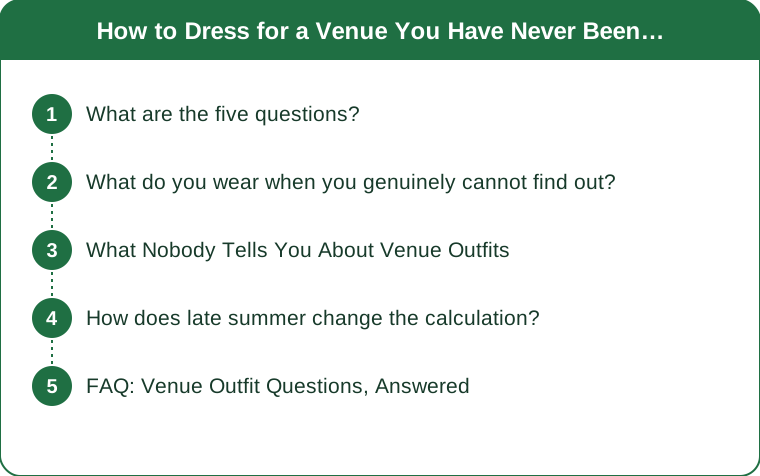
What are the five questions?
All five are answerable in about four minutes on your phone, and each one determines something specific.
1. Standing or seated? This decides your shoes more than any other factor. Three hours standing on concrete demands cushioned, broken-in footwear. A seated show does not. The venue website almost always says, and if it lists a capacity with no seat map, assume standing.
2. Indoor or outdoor? Outdoor means the temperature will drop 8 to 12 degrees between doors and encore in late summer, and it means wind and possibly wet ground. Indoor means the opposite problem - a packed room runs hot regardless of the weather outside.
3. How far is the walk? From the car park, the station, or the drop-off. A venue with parking half a mile away, or a fifteen-minute walk from the nearest station, turns an impractical shoe into an actual problem. Look at the venue’s own travel page and at a map.
4. What is the bag policy? Many venues now restrict bag size or require clear bags. Arriving with a bag that is not permitted means queuing at a bag drop or returning to the car. This is checkable in thirty seconds and catches people constantly.
5. What time does it end? Late finish means the walk back is at midnight, when it is coldest and quietest. It also determines whether you need a layer you did not need on the way in.
Where to find the answers: the venue website’s Plan Your Visit page, recent reviews mentioning the queue and the walk, and the ticket page itself for seated versus standing.
What do you wear when you genuinely cannot find out?
Default to the failure modes that cost the most. Being slightly overdressed for comfort is recoverable; being cold, blistered, and carrying a rejected bag is not.
Assume standing. Cushioned, broken-in, closed-toe shoes with a secure fit. No heels, no new shoes, no backless anything. Trainers with real cushioning outperform every fashionable option and read as entirely normal at almost every venue.
Assume a temperature swing. A base layer you would be happy in at the warmest point, plus one packable layer. Something that folds into itself or ties at the waist without looking like luggage - a light shell, a thin knit, an overshirt.
Assume a small bag or none. A crossbody that sits against your body, ideally under a jacket, small enough to satisfy most policies. Phone, card, key, lip balm, hair tie. Everything else stays in the car.
Assume you will be on your feet before and after. Queuing outside, waiting for transport, walking back. The outfit needs to work standing still in the cold as well as dancing in a warm room.
Assume nowhere to put things. No cloakroom, no chair back, no floor space. Anything you bring, you hold or wear all night. This is the assumption that most changes what people pack, and it is correct at the majority of standing venues.

What Nobody Tells You About Venue Outfits
The coat is the entire problem at an indoor autumn show. Warm outside, hot inside, no cloakroom or a 45-minute queue for one. The solution is a layer you are willing to tie around your waist or stuff into a bag, not a proper coat. People who bring a proper coat spend the night holding it.
Standing venues have floors, and floors have drinks on them. Fabric that reaches the ground, open shoes, and anything you would be upset about are all poor choices. This is not a hypothetical.
Sound systems get warm rooms warmer. A packed standing room with a full PA runs considerably hotter than the same room empty. Dress for the room you will be in at 10pm, not the one you walk into at 7.
Pockets are worth more than anything else you could wear. A zip pocket that holds a phone securely solves the biggest practical problem of a standing show, and it is the feature people forget to check for.
And the walk back is the coldest part of the night. Midnight, standing still waiting for transport, and you have been sweating. The layer you resented carrying at 7pm is the one that matters at 11:45, which is the single most common regret at outdoor shows in late summer.
How does late summer change the calculation?
Mid-August into September is the most awkward window of the year for evening events, because the day and the night belong to different seasons.
The daytime temperature is misleading. A warm afternoon can drop sharply after sunset, particularly at outdoor venues away from city centres where there is less retained heat. A 12-degree swing between doors and the end of the night is unremarkable.
Sunset is getting earlier fast. An outdoor show that started in daylight in July finishes fully dark in September, and dark is colder and harder to navigate. Check the actual sunset time for the date rather than assuming.
Ground conditions change. Grass venues that were dry in July hold dew and moisture in September evenings. Anything with a canvas upper or a suede finish will not survive it.
The practical late-summer formula: a comfortable base you are happy in at 25 degrees, a mid layer that packs to nothing, cushioned closed shoes, and a crossbody bag. Add a scarf or a light knit if the venue is outdoors and the finish is after 10pm.
And check the forecast for the end time, not the start time. Weather apps default to now, and now is not when you will be walking back to the car.
FAQ: Venue Outfit Questions, Answered
What should I wear to a concert if I do not know the venue?
Default to standing: cushioned broken-in closed shoes, a base layer plus one packable layer, and a small crossbody bag. Those cover the failure modes that actually ruin a night.
How do I find out if a show is standing or seated?
The ticket page usually specifies, and the venue’s own site will have a seat map if it is seated. A listed capacity with no seat map generally means standing.
What should I do with my coat at a standing show?
Avoid bringing one. Use a layer you can tie at your waist or compress into a small bag - cloakrooms are frequently absent or slow enough to cost you the end of the night.
TL;DR:
- Five questions decide the outfit: standing or seated, indoor or outdoor, the walk, the bag policy, the end time.
- When in doubt, dress for standing, cold, and a long walk back.
- Cushioned broken-in closed shoes and a packable second layer beat everything else.
- Check the forecast for when the show ends, not when it starts.
Four minutes of research replaces every guess you would otherwise make about what to wear - and it is the reason the walk back to the car is fine instead of memorable.
Keep Reading
This article is for general informational and styling purposes only. Fit, sizing, and product availability may vary.