The Outdoor Show Outfit for a Warm Afternoon and a Cold Night
Quick Answer: The outdoor show problem is that you dress for the queue in daylight and stand still for four hours after dark. Solve it with a packable insulating layer you can carry, closed shoes with real cushioning, and a base layer that works alone at 6pm - not with a single heavy coat you will regret carrying or leaving behind.
By late August the temperature drop after sunset is substantial, and standing still in a crowd for hours is a different thermal situation from anything you did during the day.
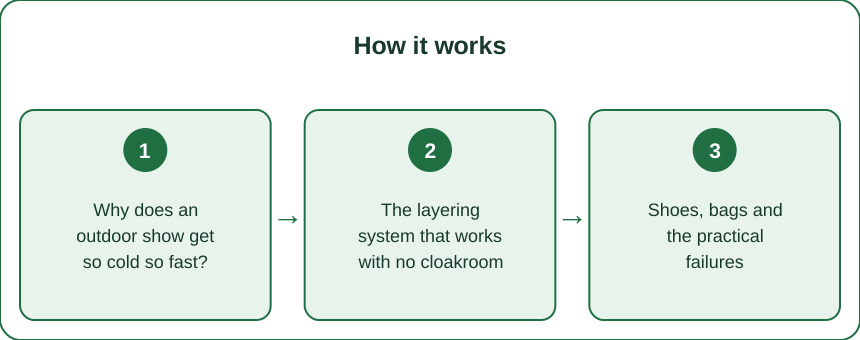
Why does an outdoor show get so cold so fast?
Three things happen simultaneously and they compound.
The temperature drop after sunset is steep in late summer. Clear skies allow rapid radiative cooling, and a 10 to 12 degree drop between 6pm and 11pm is normal in late August and September.
You are standing still. Metabolic heat production while standing is a fraction of what it is while walking. A temperature that felt fine walking to the venue feels genuinely cold after two hours of standing, and the effect is larger than the thermometer suggests.
Wind and open ground. Outdoor venues are usually exposed, and wind strips the thin layer of warm air next to the skin, which is why an open field at 14 degrees feels colder than a sheltered street at 12.
Add the specifics of a gig:
- You may be damp, from dancing or from queuing in the sun. Damp fabric against skin in the evening is the single biggest cause of being cold at a show.
- There is often nowhere to put anything. No cloakroom, no seat, no floor space you want to use.
- You are on your feet for five to seven hours, mostly on grass, gravel or concrete.
The design brief: an outfit that works at 24 degrees in a queue and 12 degrees standing still, where every layer either stays on your body or attaches to it, and the shoes survive seven hours.
The layering system that works with no cloakroom
Base layer - the piece that works alone at 6pm:
- A fitted top you are happy to be seen in on its own
- Synthetic or merino rather than cotton. This is the most important single choice - cotton holds sweat and stays damp for hours, which is why people are cold at 9pm despite adequate layers.
- Long sleeves are more useful than short, because they make the mid-layer optional
Mid-layer - the workhorse:
- A light knit, overshirt or zip-through that ties around the waist without bulk
- This is what goes on at sunset, roughly two hours before you think you will need it
Outer layer - the one that packs:
- A light packable insulated jacket is the single best item for this. It compresses to about the size of a water bottle and delivers real warmth after dark.
- A shell for rain, if the forecast requires, worn over the insulation
- Avoid a heavy coat. You will carry it for five hours and resent it for four.
Bottom half:
- Legs handle the temperature drop far better than the core, so this matters less than people assume
- Full-length is better than cropped for a late show
- Something you can sit on grass in without ruining it
The accessories that carry disproportionate weight:
- A scarf or a light snood, which closes the neck - where standing-still cold registers first
- A hat, if it gets genuinely cold
- Thin gloves in a pocket for a late finish in September
All of it needs to attach to you: jacket around the waist, everything else in a crossbody bag. Anything requiring hands is something you will put down.
Shoes, bags and the practical failures
The outfit rarely fails on warmth alone. It fails on feet and logistics.
Shoes - the item with the highest consequence:
- Closed toe, without exception. Crowds, dropped drinks, and darkness make open shoes a bad idea.
- Real cushioning. Seven hours standing on hard ground is a genuine physical load, and flat unsupportive shoes produce foot and lower back pain that lasts days.
- Broken in. A show is the worst possible place to discover a rubbing point.
- Not white, unless you have made peace with it
- A substantial trainer or a low sturdy boot is the honest answer, and it looks fine
Socks matter more than expected: a cushioned sock in a synthetic or wool blend reduces foot fatigue meaningfully and stays warmer when damp than cotton.
Bags:
- Check the venue’s bag policy first. Many now restrict size or require clear bags, and finding out at the gate is a bad start.
- Crossbody, worn in front in a crowd
- Small enough that you are not fighting it all night, large enough for the packed jacket
What to actually carry:
- A packable jacket - the highest-value item
- A portable charger, because cold drains phone batteries fast and you need it to get home
- Cash as a backup, since card systems fail at outdoor events more than they should
- A hair tie and a small pack of tissues, both of which you will use
What not to carry: anything you would be upset to lose, anything requiring two hands, and anything you cannot fit in a pocket if the bag becomes annoying.
One thing people never plan for: the walk or wait to get home afterwards, often 30 to 60 minutes at the coldest point of the night. Dress for that, not for the last song.
What Nobody Tells You About Outdoor Shows in Late Summer
Dew falls on everything after dark. Grass gets genuinely wet by 10pm, and anything on the ground - a jacket, a bag - is damp when you pick it up. Keep things off the grass, which is another argument for the packable jacket that lives in a bag.
Standing still is the whole problem. People plan for the temperature and not for the metabolic rate. You generate a fraction of the heat standing that you do walking, which is why the same clothing that was fine on the way there fails at the venue.
Sweat from the afternoon is what makes you cold at night. If you queued in the sun and the base layer is cotton, it is still damp at 9pm and it is actively cooling you. The fabric choice at 4pm determines how cold you are at 10pm.
Phone batteries drop sharply in the cold, and you need the phone for tickets, transport and finding people. Keep it in an inside pocket rather than an outer one, and bring a charger.
The queue is often the warmest part of the night and the least pleasant. Dress so the outer layers are removable at the gate rather than arriving already overheated - being sweaty before the show starts is the beginning of the problem.
Venue security policies vary and change. Bag size limits, prohibited items and re-entry rules are worth a two-minute check on the venue’s site. Umbrellas are commonly prohibited, which matters if rain is forecast - a hood is the answer.
Late September outdoor shows are a different proposition entirely. By then the drop after dark is larger and the ground is colder. The packable jacket becomes non-negotiable rather than sensible.
FAQ: Outdoor Show Outfits, Answered
How much colder does it actually get after dark?
Often 10 to 12 degrees between early evening and late night in late summer, and it feels colder still because you are standing still and often in an exposed space.
What is the single most useful item to bring?
A packable insulated jacket. It compresses to almost nothing, delivers real warmth after sunset, and does not become a burden the way a heavy coat does.
What shoes should I wear?
Closed-toe, cushioned, and broken in. Seven hours standing on hard ground is a real load, and unsupportive flat shoes produce pain that lasts for days.
Why am I always cold by the encore?
Usually a damp cotton base layer from the afternoon. Synthetic or merino next to the skin makes the largest single difference to how you feel at 10pm.
Should I bring a bag?
Yes, but check the venue’s policy first - many restrict size or require clear bags. Crossbody worn in front, small enough to forget about, large enough for the packed jacket.
TL;DR:
- Expect a 10 to 12 degree drop after sunset, made worse by standing still in the open
- A synthetic or merino base layer determines how cold you are at 10pm, not the jacket
- A packable insulated jacket beats a heavy coat you will carry for five hours
- Closed, cushioned, broken-in shoes - seven hours on hard ground is a genuine load
- Dress for the journey home, not for the last song
The queue is warm, the encore is cold, and the walk home is colder. Build the outfit backwards from the last of those three.
Keep Reading
This article is for general informational and styling purposes only. Fit, sizing, and product availability may vary.