The Outdoor Show Outfit for an 80-Degree Doors and a 55-Degree Encore
Quick Answer: Outdoor venues in late summer routinely drop 25F between doors and the encore, and most venues won’t let you return to your car. Dress for the cold end and stay comfortable at the warm end by using one packable layer plus a base you can wear alone. The two decisions that matter most are footwear you can stand in for four hours and a jacket that compresses small enough to tie or stuff without becoming a problem.
Doors at 6:30 and it’s 82F. Encore at 10:45 and it’s 56F, you’re sitting on concrete, and the car is a twenty-minute walk away.
This specific problem has a specific solution.
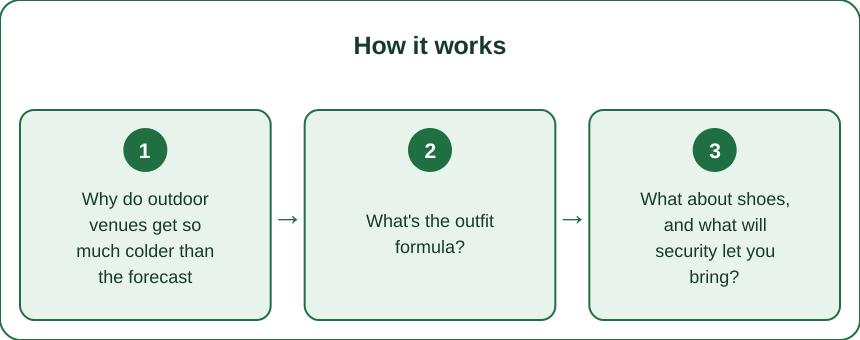
Why do outdoor venues get so much colder than the forecast suggests?
Several factors compound after sunset, and none of them show up in a daytime forecast.
Radiative cooling accelerates once the sun goes down. On clear late-summer nights, surfaces release the day’s stored heat rapidly and the temperature falls faster than most people expect - often several degrees within the first hour after sunset.
Amphitheatres and open fields are exposed. No buildings to hold heat, no trees to block wind. Many outdoor venues sit in valleys or on hillsides, which are the exact places cold air collects overnight.
You stop generating heat once the show starts. Walking in from the car keeps you warm; standing or sitting for three hours doesn’t. People consistently misjudge how they’ll feel based on how they feel while arriving.
Concrete and metal seating conduct heat away. Sitting on a cold surface for hours cools you far more than the air temperature alone, which is why the last hour at an amphitheatre feels disproportionately cold.
And humidity often rises after sunset, which makes a given temperature feel colder against skin.
The practical number: check the overnight low rather than the evening temperature, and assume you’ll feel colder than that because you’ll be still, possibly damp, and sitting on something cold.
What’s the outfit formula?
Three components, chosen for how they behave over four hours.
1. A base you’d wear alone at 80F. Fitted tee, tank, or a simple top. This is the doors-time outfit and everything else is temporary.
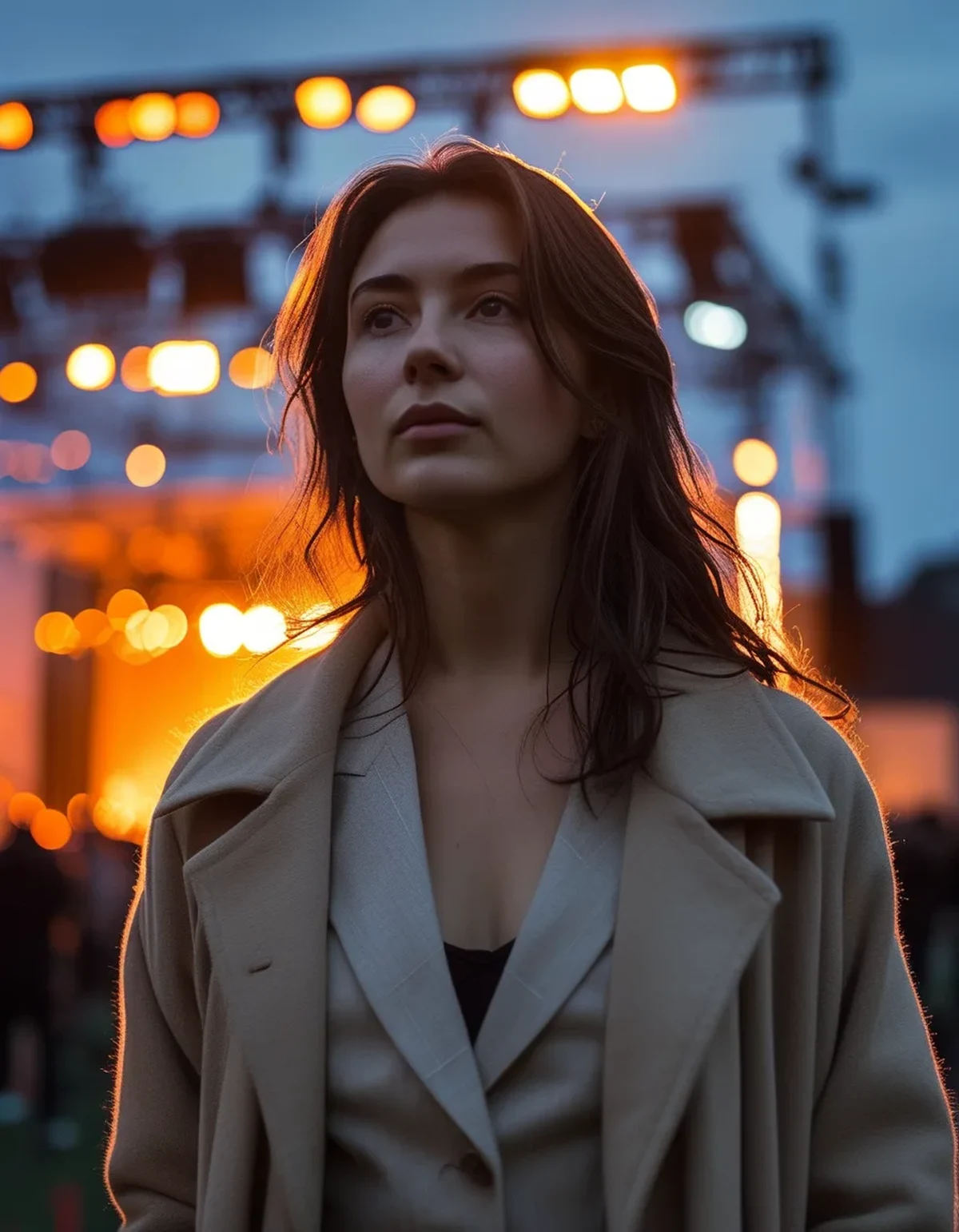
2. One packable warm layer. The critical piece. The selection criteria are how small it packs and whether it survives being tied around your waist for three hours.
Good options: a lightweight down or synthetic puffer that stuffs into its own pocket, a thin fleece, an oversized flannel shirt. Bad options: anything structured, anything wool that will stretch out around your waist, anything you’d be upset to see get dirty.
3. Bottoms that work sitting on a cold surface. Full-length is warmer than the equivalent shorts, obviously - and the specific issue is contact with cold seating. Jeans, full-length leggings, or trousers. A skirt or shorts means bare skin on cold concrete for three hours, which is the single most common regret.
The optional fourth: something for the neck. A light scarf or bandana weighs nothing, packs to nothing, and does a disproportionate amount for perceived warmth. It’s the highest ratio of comfort to bulk available.
What to leave behind: a proper coat. You’ll carry it for three hours before you need it, venues often restrict bag size, and there’s usually nowhere to put it down.
What about shoes, and what will security let you bring?
Two practical constraints that shape the whole outfit.
Shoes: you’ll be standing for three to four hours on uneven ground.
What works: trainers, flat ankle boots, chunky-soled loafers. Cushioning matters more than style at hour three, and the ground at outdoor venues is frequently grass, gravel, or sloped concrete.
What doesn’t: any heel on grass, brand new shoes, backless anything in a crowd, and open-toe shoes if there’s any chance of rain or mud. Closed shoes also stay considerably warmer once the temperature drops, which is the autumn-specific reason.
A pair of thin socks in a pocket is a genuinely useful trick if you’ve worn something without them.
Bag policies are the other constraint, and they’ve tightened at most venues. Clear bag policies and small size limits are now standard at many larger outdoor venues. Check the specific venue’s policy before you leave - this is the most common way people end up returning to the car or abandoning something.
What that means for the jacket: it can’t live in a bag that isn’t allowed. A jacket that ties around the waist or packs into its own pocket sidesteps the problem entirely.
Small items that consistently earn their space: a portable phone charger, a hair tie, and cash as a backup. Phone battery drains faster in cold weather, which catches people out when they need it for a rideshare afterwards.
What Nobody Tells You About Late Season Outdoor Shows
Five things learned the hard way.
You cannot go back to your car at most venues. Re-entry is prohibited at the majority of larger outdoor venues, so whatever you left in the car is gone for the night. This single fact should drive the whole packing decision.
The walk out is the coldest part of the night. By 11pm you’re tired, possibly damp, and walking to a car park in the coldest hour. People dress for the show and forget the twenty minutes afterwards, which is when they’re actually most exposed.
Grass gets wet with dew well before the show ends. A lawn seat that was dry at 7pm is damp by 9:30, and anything you put down - a jacket, a bag - comes back wet. A cheap plastic poncho or bin bag folded in a pocket solves it for almost nothing.
Standing still is colder than walking in the same temperature. Muscle activity generates heat, and three hours of standing still produces far less than the ten-minute walk in. This is why arriving comfortably warm reliably misleads people.
Layers you can put on one-handed matter. In a crowd, holding a drink, in the dark - a jacket you have to put a bag down for is a jacket you won’t put on. A zip-up or a shirt beats anything you pull over your head.
FAQ: Outdoor Concert Outfit Questions, Answered
How much colder does it actually get?
Check the overnight low rather than the evening temperature and expect to feel colder than that number, since you’ll be still and possibly sitting on cold seating. A 25F drop between doors and the encore is common in late summer.
What if the venue doesn’t allow bags?
Choose a jacket that ties around your waist or compresses into its own pocket, and put essentials in pockets. Many venues allow a small clear bag - check the specific policy before leaving, since it varies considerably.
Are shorts or a skirt ever a good idea?
At a hot early show that ends before sunset, yes. For anything running past dark, bare legs against cold seating for three hours is the most consistently regretted choice. A midi length with boots is a reasonable compromise.
What’s the single most useful item?
A packable jacket that stuffs into its own pocket. It solves the temperature drop, the walk out, and the bag restriction simultaneously, and it costs nothing in comfort during the warm part of the evening.
How do I stay warm in a lawn seat?
Something waterproof to sit on, closed shoes, full-length bottoms, and a layer for the neck. The cold comes up from the ground more than it comes in from the air once you’re sitting.
TL;DR:
- Outdoor venues drop around 25F between doors and encore, and radiative cooling accelerates after sunset
- Most venues prohibit re-entry, so what’s in the car is gone for the night
- Formula: a base you’d wear alone at 80F, one packable warm layer, and bottoms that handle cold seating
- Choose the jacket by how small it packs and whether it survives being tied around your waist
- Closed cushioned shoes - you’re standing three hours on uneven ground and they stay warmer
- The walk out at 11pm is the coldest part of the night, and it’s the part nobody dresses for
Dress for the encore. You’ll survive the doors.
Keep Reading
This article is for general informational and styling purposes only. Fit, sizing, and product availability may vary.